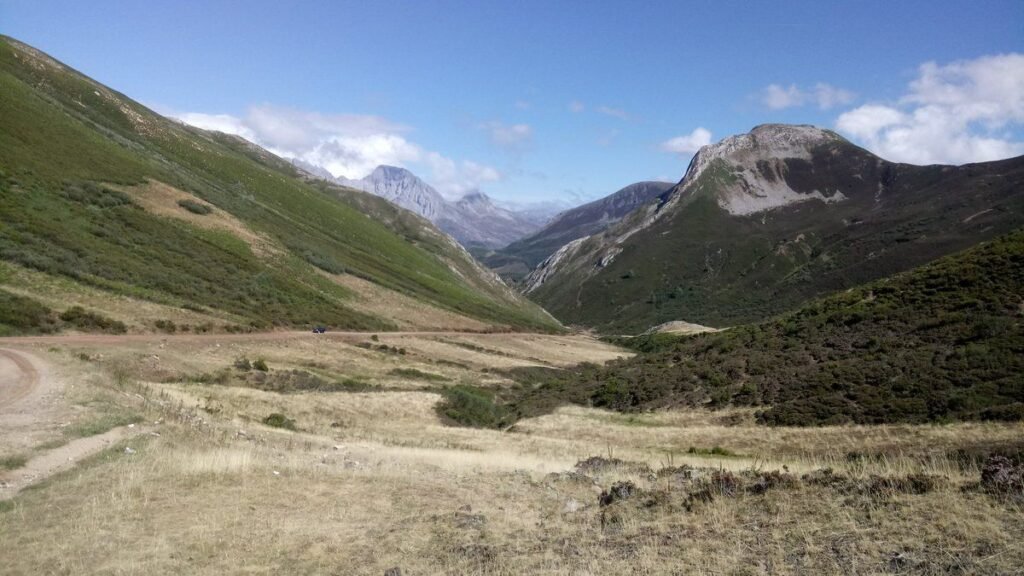
In western Asturias is the wonderful mountainous natural park of Somiedo, a UNESCO Biosphere Reserve. It is formed by four deep valleys, mostly cloaked in thick woods of beech, oak and birch. This woodland is gradually expanding as the area’s old hay meadows are slowly abandoned. Higher up Alpine pastures known as teitos are grazed by cows. Here are there stand broom-hatched stone huts known as teitos, used until recently by transhumant cattle herders. The huts are often collected together into little “villages”.
Somiedo was one of the last refuge of the Cantabrian brown bear in the 1980s before its recovery across the mountain range. I was fortunate enough to watch a female bear through a telescope here some years ago, feeding on hazelnuts, the guide informed us.
Somiedo is among the best places in Europe to see a bear not lured to a feeding station, a practice widely used in Eastern Europe guaranteeing close-up views. This is not so only because of the reserve’s very healthy population – some 60 bears were counted here in 2017, but also because the mosaic of landscapes, with thick forest giving way to open pastures laid on scannable slopes – mean that they are easy to spot than in, for example, the deep woods of Romania. In this sense it is analogous with the relative ease of watching wolves the Sierra de la Culebra in Zamora. Several wolf packs are present in Somiedo but are difficult to spot. A good start with the bears is the Casa del Oso in Pola de Somiedo, one of a series of “Houses of the Bear”, small interñtetation centres run across the region and in Catalonia by the Fundación Oso Pardo (FOP). Among the exhibits are several gruesome antiques for trapping bears.
When Somiedo was declared a natural park in 1988, there were just xxx bears in its forests and no rural tourism hotels. Now 50-60 bears inhabit the park. There are also some hundred rural tourism businesses, made of whose clients are attracted by the image of the bear, even if they don’t end up seeing one. A key is that 40% of the land is restricted to bears and other wildlife, while the rest is managed by an excellent network of paths and bridleways. Bearwatching brings money and stops depopulation.
The staff at the Casa de Oso also run informative tours (4 hours, 40 euros in 2017). Jorge, our guide, took a group of us up a hillside grazed by bears. We came across a huge stone a bear had overturned the night before to get at the eggs of an ant nest. The few remaining ants looked lost and disorientated after the terrible force which had struck their colony. Later, mist forced us further down the valley to the village of Gua, from where with Jorge’s help we watched through scopes for 15 minutes a juvenile bear feeding on hazelnuts growing on the screes opposite. Gua also has a good museum on local rural traditions (clog making, transhumance). If you have your own scope, try scanning opposite mountainsides from parking areas in villages of Gua and La Peral (look out for fellow watchers and ask them), or ask around.
Most people in Asturias seem to love their bears and the animal has become a token of identity, an almost nationalist symbol. That said, I’ve talked to plenty of older people in villages whose attitudes are more ambivalent, some of whom you fancy might happily shoot or snare a bear if they thought they could get away with it. “Bears are more protected than humans here”, an old fellow in village in one of Somiedo’s more secluded valleys told me, reflecting a wider lament of a dying rural society. Not a single child had been born in the valley for years, he said.
There are also several packs of wolves in the area, although spotting one is much harder
Among the other mammals, chamois, known as rebeco in Spanish, are easy to spot fairly close on the higher slopes, while red and roe deer and boar feed further down. Somiedo has good populations of wildcat, otter, badgers, pine martens and Pyrenean desman though you’ll be lucky to see any. Somiedo is excellent for raptors in particular Egyptian and Griffon Vultures and Common Buzzards
A hike I particularly enjoyed was to the Lago del Valle (Somiedo’s largest glacial lake) through high pastures. Egyptian Vultures, Griffon Vultures, Golden Eagles and Honey buzzards are all common. You’ve also a good chance of seeing chamois.