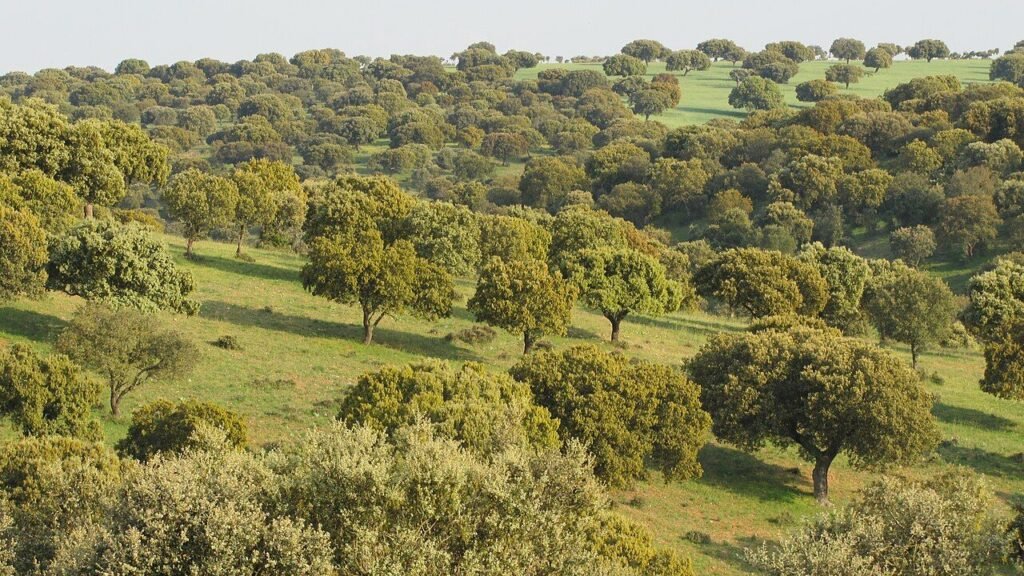
Dehesa is an open wood pasture made up principally of holm and evergreen cork oak, grazed by livestock, and without scrub undergrowth. It is unique to Spain and Portugal, covering huge areas of southwestern Iberia, and parts of the Magreb.
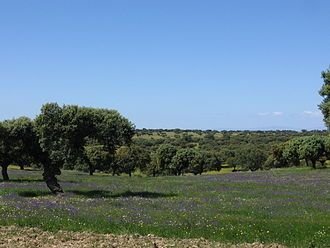
The holm oak is believed to be the climax species of the true Mediterranean forest, which once stretched over great swathes of the peninsula. In some areas it will have been thick woodland, but more often natural grazers (auroch, bison, deer, etc) would have kept it open. This virgin forest has long-since disappeared through grazing, charcoal-burning and felling. A few patches of something approaching it survive here and there. Much of the forest grew on poor, arid soils, and when the trees came down, the soil could not support agriculture for long and was soon abandoned, to be taken over by maquis, which covers much of Spain and the Mediterranean in general today. However, particular in the southwest of the Iberian Peninsula, instead of being cut down, the forests were thinned out and used for grazing. This created a sparse woodland known as dehesa in Spain and montado in Portugal, typically combining both holm and cork oak. Dehesa is therefore a manmade, managed ecosystem.
However, importantly, it is perhaps it’s not so different from what was here before humans took their toll. Some scientists have argued that southern Iberia may well have been covered, rather than in a dense forest, in something like a savannah-like open woodland grazed by large numbers of herbivores. What makes it unique is that it supports high levels of biodiversity while at the same time being economically viable. Indeed dehesa plays an essential role in European bird migration and in the survival of many resident Spanish birds.
Money comes from charcoal production, mushroom, wild artichokes, asparagus harvesting, cork production and hunting. It is often grazed on by sheep, cows and goats, and above all by those classic Iberian pigs which wander around snuffling up huge quantities (6-7kg a day) of the oak’s sweet acorns and produce jamón ibérico, for some simply the finest food you could ever wish to roll around your mouth. Prices rise from here up to 500 euros a kilo and more, depending on how long they have been cured and which particular estate they have come from, like a vintage wine which only the wealthy can pay for. I suspect many Spaniards might choose a plateful as a last meal on death row.
Agriculture in the dehesa
The thin soils of the dehesa are generally incapable of supporting intensive agriculture. The system comes in different forms, but at its heart it’s involves cereal production planted in an open woodland. Ideally the system evolves over the years. First a cereals are planted per year, and then this is left to pasture for several years allowing pigs, cows and sheep to graze and then allowed to revert to scrub, this is fallow period allowing the land to recover. The land is then burnt or cut and plowed and sown again. This produces a continuously shifting pattern of land use across the landscape. it is then allowed to return to ceaeal production
Rocky and wet areas are always left and so act as wildlife havens, especially during the farming years. However, cereal production these days is becoming quite rare, now only representing 10% of dehesa lands.
This method of farming is also interesting because instead of producing one crop, it rather yields an array color most importantly grazing land for livestock, fodder, some crops, cork and charcoal, wild mushrooms, herbs and game.
The quantity of grasses means that livestock is kept at much lower levels per hectare than in northern Europe. And only in the winter, while the rest of the year they are fed on fodder or traditionally herded to Northern Spain for the winter pastures as part of the old transhumance system.
Holm oak
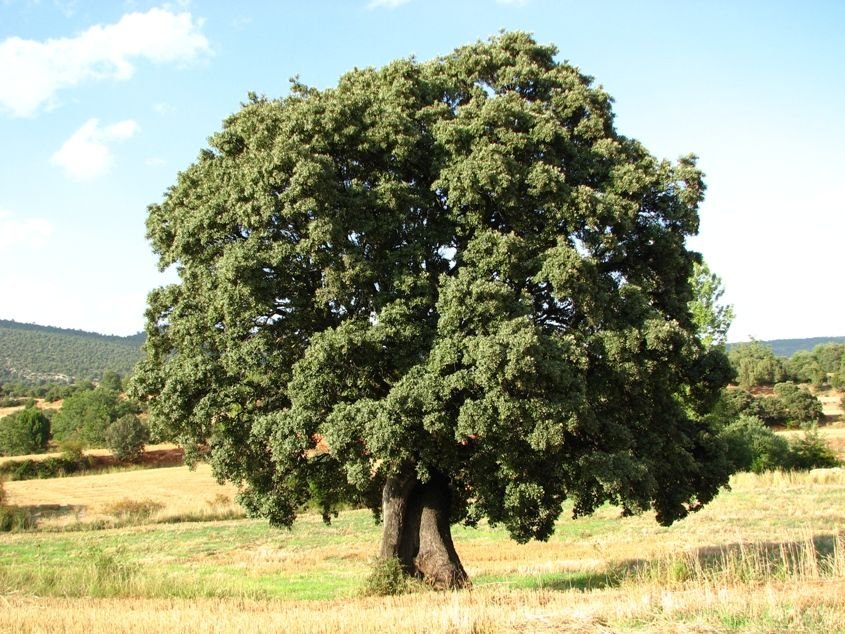
The evergreen holm oak (Quercus ilex – encina in Spanish) is the defining, almost essential element of the Spanish Mediterranean landscape. It has been said that the tree was once as important to the Spanish peasant as the seal was to Eskimos. Hyperbole apart, the encina was certainly a cornerstone of traditional culture and substance. Holm oak acorns have much lower levels of tanins than those of common oaks, making them a good substitute for wheat flour when ground up. They can also be roasted and eaten like nuts.
Antonio Machado, the great 20th-century Spanish poet put the importance of the tree in these terms:
El campo mismo se hizo árbol en tí, parda encina.
The countryside became a tree in you, brown oak
Note los Pedroches in Córdoba is the largest dehesa in the world.
Threats to the dehesa
The dehesa is threatened by a complex of set of pathogens known collectively as the Seca de la encina affecting holm oaks (encinas), cork oaks (alcornoques).
Los Santos Inocentes
The dehesa was beautifully depictured in Mario Camus’ “Los Santos Inocentes”. The film, set on a cortijo in Alburquerque in Badajoz , is a harrowing indictment of the semi-feudal relations of absentee landowners, estate managers and peasants in 1960’s rural Spain . Although we may indeed praise the dehesa as a production system, there should be no nostalgia felt towards the retrograde social system that all too often in the past operated around it. Essential viewing for any nostagics for the “Real Spain”.