September 23, 2004
At just after 17.48 p.m. yesterday, I was sitting around the table at home in Barcelona picking at cheese when we felt a slight tremor. Slight though it was, it was unmistakable. The earthquake measured 4.1 on the Richter Scale and had its epicentre some 200km away in Queralps in the Catalan Pyrenees. In the village there was some minor damage and frayed nerves. Slight tremors are a common occurrence in the Pyrenees. More than 200 are recorded in Catalonia every year, but there’s only one as strong as this one every five years or so.
The Iberian Peninsula is only at moderate risk from earthquakes, although every two hundred odd years one as big as six on the Richter Scale will inevitably occur. Iberia, once a plate of its own, is squashed between Africa and Eurasia, and is now fused to and part of the latter. That old saying that Africa begins at the Pyrenees is geologically wrong as well as being xenophobic horseshit, but in a very real tectonic sense Europe did once begin at the nascent Pyrenees. Although major friction is, for the time being, a thing of the past, ever so slowly and ever so powerfully the African and Eurasian plates still push up against each other, and this most commonly manifests itself in the Pyrenees, themselves forged, folded and formed by the ancient clash of the two plates; and in the south-west of the Peninsula, which lies closest to the fault line. That said, Iberia is in no way as active as Southern Italy, Greece or Turkey, where the full weight of Africa is in the process of shearing under Eurasia.
There are dozens of examples of destructive earthquakes in the Iberian peninsula in recent centuries. The worst earthquakes in the Pyrenees in the historical record were in the Olot region in 1427 and 1428 with intensities of greater than X*. (An X-intensity earthquake means most buildings are damaged or destroyed. Roads and brides get buckled and broken. Cracks open up in the ground. Rivers are thrown from their course). This assumes historical descriptions are reliable. It seems they were. Olot was totally destroyed, with extensive damage across Gerona. In excess of 800 people were killed. Since the 15th century there have been 17 earthquakes in the Pyrenees with an intensity greater than VIII and, four greater than IX.
Serious earthquakes also occur in Andalusia in the Cordillera Bética, and to a lesser extent in the Guadalquivir Depression. The single most deadly earthquake in modern Spanish history occurred in Arenas de Rey in Granada in 1884 (see photo above) with an estimated magnitude of 6.5-7 (Richter) and an intensity of 10 (MSK). Almost 800 people were killed and 1,500 were injured. 14,000 homes were destroyed. Clearly, an earthquake today in Spain would be serious, but it would not cause anything this amount of destruction. And, the fact that that many years tend to pass between one and the next means there is little awareness of the tiny but potential risk. There is no folk memory. Then again, why should there be. Hundreds die on the roads every year and we continue to get into our cars. Just because something is more spectacular does not mean it is more risky.
Right: More than 2,500 people were killed in and around Almeria on 22/9/1522

Most significant earthquakes in Spain (1300-2004)
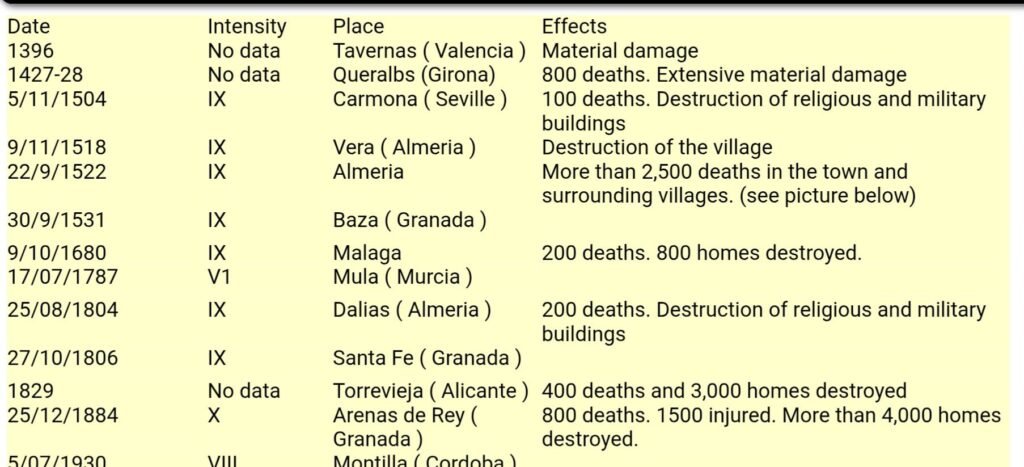
Place
Effects
1396
No data
Tavernas ( Valencia )
Material damage
1427-28
No data
Queralbs (Girona)
800 deaths. Extensive material damage
5/11/1504
IX
Carmona ( Seville )
100 deaths. Destruction of religious and military buildings
9/11/1518
IX
Vera ( Almeria )
Destruction of the village
22/9/1522
Intensity
IX
Almeria
More than 2,500 deaths in the town and surrounding villages. (see picture below)
30/9/1531
IX
Date
Baza ( Granada )
9/10/1680
IX
Malaga
200 deaths. 800 homes destroyed.
17/07/1787
V1
Mula ( Murcia )
25/08/1804
IX
Dalias ( Almeria )
200 deaths. Destruction of religious and military buildings
27/10/1806
IX
Santa Fe ( Granada )
1829
No data
Torrevieja ( Alicante )
400 deaths and 3,000 homes destroyed
25/12/1884
X
Arenas de Rey ( Granada )
800 deaths. 1500 injured. More than 4,000 homes destroyed.
5/07/1930
VIII
Montilla ( Cordoba )
19/04/1956
VIII
Albolote ( Granada )