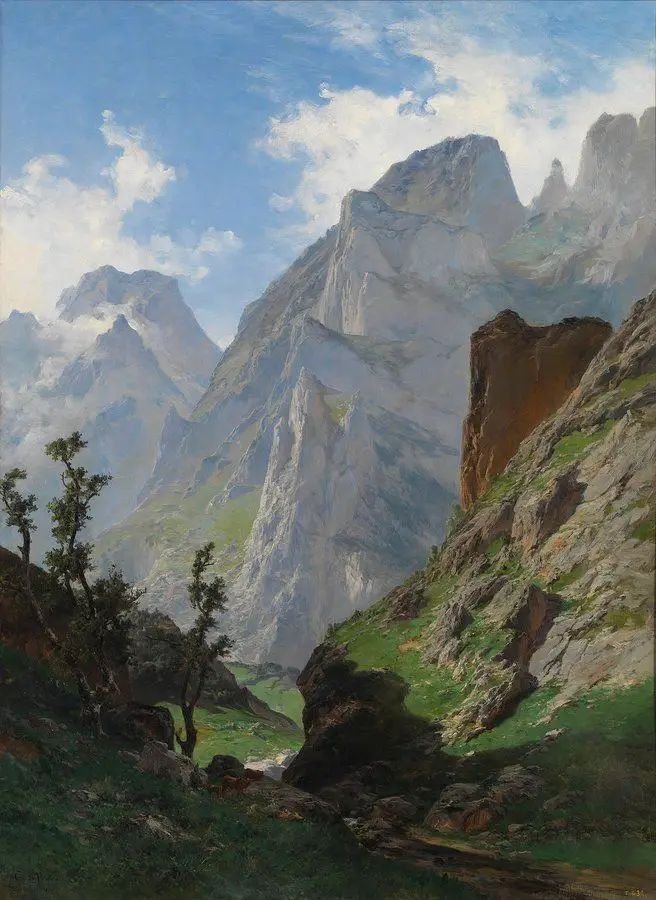
Straddling Asturias, Cantabria and León, the highest and arguably the most spectacular mountains in the Cantabrian range are the Picos de Europa. The most common theory claims the Picos get their name from the fact they were the first land to be spotted by sailors returning home from the Atlantic. These limestone peaks are younger than most of the Cordillera Cantábrica and so have been less subject to weathering. They were heavily modified during the ice ages leaving today a glacial-karstic landscape of jagged peaks, deep valleys, cirques and tarns. The range is spilt into two massifs (Western and Eastern by the dramatic Cares gorge, at whose heads stands the village of Caín (see below).
The Cares was famed as a salmon river although as of 2026, the fish is nearing extinction in Asturias, despite the fact that the regional government continues to permit it’s capture. Blue rock thrush are present in the gorge.
Fuente Dé cirque and Alping pastures
An excellent access to the high Alpine pastures of the Picos is by the Fuente Dé Cable Car in Cantabria in the central massif of the range. It takes you up a dizzying 753 metres past the sheet rock faces in four terrifying or exhilarating minutes, depending on your head for heights, to the wonderful alpine meadows of the Puertos de Ávila at height of 1850m. The cable car (teleférico in Spanish) is the longest single-span aerial lift in Europe. There isn’t much to Fuente Dé itself save for a campsite and a few bars, but its situation at the foot of the cliffs which tower around forming an incredible glacial cirque is very impressive indeed. Once at the top there is great hiking in gorgeous Alpine wildflower pastures all around including up to Peña Vieja or Pico Tesorero (2570 m). This is probably the most easily accessible site to see alpine birds in the whole of the Cantabrian Mountains including ellow-billed chough, wallcreeper, white-winged snowfinch and alpine accentor Alternatively, from here you can walk 2.5 miles to the Refugio de Aliva, which serves snacks and drinks. From here you can take the path down to Espinama below, a few kilometres down the road from Fuente Dé. Avoid Easter weekend and other big holidays.
Chamois are also a common sight above treeline.
While highest point in the Picos is Pico Torrecerredo peak (2,648 m), perhaps the most striking mountain is Naranjo de Bulnes, which is exactly 88km from the nearest three provincial capitals: Oviedo, Santander and León. It is known as Naranjo (or Naranco) de Bulnes because of its orange hue in the evening light.
Naranjo de Bulnes
Naranjo de Bulnes is a limestone horn of almost sheer walls which rises above the village of Bulnes to more than 2,500 metres. Its base resembles an immense chunk of bread. Until well into the spring its fissures and crags are adorned with blankets of snow. Climbing Picu Urriellu is extremely difficult, and although each of its faces has been conquered, it is still by far the Spanish mountain to have claimed most lives of climbers. Mountaineers employ the latest gear and methods to make its ascent. The sophistication of their equipment is incredible. However, as is often the case, the first climb was the simplest of all, and for that, the most incredible. A few photographs remain of the two participants. The first to conquer Picu Urriellu was Pedro Pidal, the Marques of Villaviciosa, in the summer of 1904, at a time when the contemporary fashion of the sport added a certain charm to the life of an aristocrat. He was accompanied by Gregorio Pérez acting as a guide, a shepherd from the village of Cain, who was known as ‘El Cainejo’. The gear of the two climbers was made up of a haversack with something to eat and a couple of ropes … The Marques wore gaiters and hunting boots and El Cainejo, espadrilles.”
(From Manuel de Lope ‘s Iberia: La Puerta Iluminada parte 1 (2003) – my rough and adapted translation)
Origins of Spanish conservation
Pidal had to be quick with the declaration as the Catalans to the east were playing a similar game with their own mountains. Mountaineering, rambling and a love of natural history enjoyed genuine popular support in Catalonia at the time, far ahead of the rest of Spain (except, unsurprisingly, the Basque Country), and the Catalan authorities wanted to declare Montserrat as the first National Park in Catalonia and Spain as an expression of Catalan nationalism. Pidal declared in the Spanish Senate in 1918 that the State must declare a Spanish National Park ‘before the Catalans do so’. He was a man of his times and class, and was finally dismissed from his post as Commissioner General of National Parks during the Second Republic to be replaced by someone with more egalitarian and democratic views. Of El Cainejo, there is little more. He probably went back to his sheep and hunting deer, though there is a monument to him in Asturias.
One is reminded of the colonial relationship of Sherpa Tenzing and Edmund Hillary. El Cainejo in his espadrilles accompanies the Marques in his boots. The Marquis went on to play a pivotal role in Spanish natural history and conservation. He visited Yellowstone and on his return successfully campaigned for the creation of Spain’s first National Park, Montaña de Covadonga in 1918. The Cordillera Cantabrica is the birthplace of Spanish conservatism and mountaineering. Pedro Pidal chose Covadonga as the site of Spain’s first National Park with reason. As a Spanish nationalist he decided to make the declaration of the Park on the 1,200 anniversary of the supposed battle of King Pelayo, in an attempt to establish a certain parallelism between the onset of the so-called Reconquista and the new Re-conquest of nature which he wanted to set into motion with the Park’s creation.
Republican bear
Incidentally, King Pelayo’s son was killed by a bear in Covadonga. The symbolism was not lost on Spanish republicans when they paid a satirical homage to the ‘regicide bear’ in a celebration held on the day of Felipe’s and Leticia’s wedding in 2004, proclaiming ‘If it is true that Covadonga and Pelayo are the cradle and the base of the current Spanish monarchy, as the Asturian monarchical tradition has it, then it must be no less true that Favila and the regicide bear are the starting point of Spanish republicanism”. The act concluded by declaring the bear, ‘ the bear to be “the first Spanish republican”. To my knowledge the tradition of honouring the bear has continued every year in the village since. Here’s a news report from 2026.