Noticias en ‘Trees’
December 26th, 2008
I found a palette of colours as autumn turned to winter in Collserola. It’s at this time of year that the variety of trees is most visible: the darker green of holm oak (Quercus ilex), the silvery olives (Olea europaea), the broccoli-green of stone pines (Pinus pinea), and the yellow-brown of deciduous oaks (Quercus cerroides), who are in no hurry to shed their leaves.

The constant rainfall this autumn – not the usual torrential storms, but steady day-long rain – has made moss and lichen flourish. A startling rock by the path is encrusted with orange-yellow lichen on top, and emerald-green moss on the side. The ground is a constellation of moss and earth stars, most of which have already popped. A vivid dark red fungus (a species of Russula) has pushed up through the pine needles, like a mole tunnelling its way out the ground.


A plastic strip tied to a tree guides you up the overgrown terraces, long abandoned. Butcher’s broom grows in the gloom, hung with smooth red balls. A gang of Pekin robins (Leiothrix lutea) express their displeasure at my presence with angry rasping calls. I climb up to the ridge, where spiny Mediterranean gorse (Ulex parviflorus) flowers among the rocks. You can see that Montseny is still powdered with snow, while the Pyrenees are solid icing-sugar white.
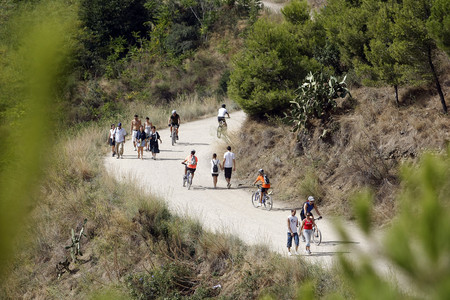
Instead of following the ridge back to Vallvidrera, I decide to take the path that skirts the coolest, shadiest corners of the valley. With so few shopping days left before Christmas, it’s very quiet. Probably only a handful of mountain bikers have passed all day. The wings of chaffinches vibrate inside a wild olive. The smallest member of a roving mixed flock, a goldcrest (Regulus regulus), investigates the tip of an oak branch.

The path steepens and it’s almost impossible not to run down . . . straight into a tribe of boars, who scatter through the leaf litter. A male with visible tusks gallops up the slope, where he stands huffing and puffing among the trees, staring belligerently. Poor light and the excitement of the moment has resulted in a less than clear image.

After they finally disperse, I reassure myself that no one in Collserola has ever been attacked by a boar. Their population in the park is estimated at 650 and rising. This season, the hunting clubs of the Collserola region are on strike in retaliation to new restrictions on their activities. Their demands have been partly met: they can continue killing thrushes, for instance. But rabbit shooting is still not permitted in the woods, and the number of days when hunting is allowed in the park has not been increased. So the hunters are envisaging a Collserola so overrun with rampaging boars that the administrative powers will come on bended knee next year and grant them all they desire.
Meanwhile, the boar population is controlled to some extent by forest rangers, who shoot the ones that leave the park limits to explore urban areas. This upsets the residents, some of whom can’t resist feeding the inquisitive beasts and become fond of them. After taming the boars, they have the unpleasant surprise of coming home to a bloodstained street and bodies piled up by their front doors.
Barcelona, Collserola, Mammals, Trees, fungi | Tags: boars in Barcelona, earth stars, goldcrest, hunting in Collserola, increase of boar population, Leiothrix lutea, Quercus cerroides, Quercus ilex, Regulus regulus, sus scrofa, trees in Collserola|

Just before pulling into Olot, the bus passes the dramatically positioned village of Castellfollit. A vast senyera¹ draped from the church tower catches your eye. In Olot town centre, people crowd into the narrow streets, filled with market stalls on a Saturday morning, to a soundtrack of sardanas². This La Garrotxa, deep Catalunya.
¹ Catalan flag ² traditional Catalan dance music
As we walked out of town, the sun grew stronger, and the majestic snow-laden Pyrenees came into view, where hordes were skiing away the long weekend – the Puente de la Constitución. The mellow, late autumnal weather suited the gentle landscape of rounded hills - many of them volcanic cones -, fields, farmhouses and woods. Soon we were mingling with beech trees.

The reason the Fageda¹ d’en Jordá survives is presumably the lava flow on which it grows, which makes the land not worth cultivating. It’s surprisingly flat and - at 550-600m - low for an Iberian beech wood so near the southern edge of the tree’s range. In nearby Montseny, much more under the Mediteranean’s influence, beeches grow mainly between 1300-1700m.
¹ Beech wood
The Fageda’s accessibility means that on Sunday mornings it can feel like a genteel park, where people stroll sedately and bid each other good day. If men still wore hats they’d be doffing them. A final touch would be to hide speakers in the bird boxes to broadcast sardanas.
But on Saturday afternoon it was so peaceful you could hear a murmuring of decomposition from the thick carpet of coppery leaves, recently-shed. The beautiful monotony of the wood casts a spell as you wander around, endlessly repeating the here and now.
For beeches are good at fending off other species of trees and plants. They are experts at monopolising light, water and nutrients. Their weapons are a densely knit canopy, widespreading roots and copious leaf litter to smother the ground. Their leaves even contain a compound that impedes the germination of other plants.
Outcrops of black volcanic rock – resembling the carbon¹ naughty children get at Christmas – push out of the leaf bed and disrupt the uniformity. The rock is used in long stretches of moss-softened walls.
¹ sweets that look like lumps of coal

Our destination was Santa Pau, a fortified Medieval village, so picturesque that from a distance you can see camera flashes going off as visitors prowl its walls. Bags of fesols are sold – the local speciality of dried beans – though the sheer quantity of beans for sale makes you wonder if they’re all locally grown.
The next day we found a wilder, steeper beech forest on the higher slopes of the Serra de Finestres, which guards La Garrotxa to the south. The walk took us through contrasting woods: in a sheltered corner of the hills there were evergreen Holm oaks, densely tangled with creepers, typical of a Mediterranean climate. These gave way to deciduous oaks, the pale sun shining through their mustard-coloured leaves. Finally, higher up, we entered the clean silent grandeur of beech wood, whose leafless branches look like smoke from a distance.

Once at the top, looking south, the other face of the mountain was formed of exposed cliffs, like a waistband above skirts of dark green Holm oak. On a clearer day we would’ve seen the Costa Brava from up here, as well as the Pyrenees to the north. In the ruined walls near the Santuari de Santa Maria, excursionists were feasting on freshly grilled butifarras¹ and wine, and we were cordially invited to join in.
¹ sausages

Soon clouds started to settle on the sierra, and we began the descent. Smoke from the farmhouses merged with the mist, and flocks of chaffinches and hawfinches flew up from the fields. Two hunting dogs, with bells attached to their collars, came along the track, out on their own excursion. Woodpeckers tapped industriously. As the mist dropped lower, the day slowly turned to night.
Trees, Trip reports | Tags: autumn walk, Beech, fageda d'en jorda, Fagus sylvatica, Garrotxa, Holm oak, Olot, Quercus ilex, Santa Pau, serra de finestres|
Bitterly cold winds keep people out of the park. In a low season atmosphere, the gardeners are cleaning the pond and cutting the hedges. The rows of lime trees are nearly bare, their last leaves flying across the grass. Only the Ginkgos are still in full flare, with a pool of fan-shaped leaves accumulating beneath.

Another source of intense colour, though much more condensed, are the firecrests, plentiful this season, and mixed up with assorted tits and the occasional goldcrest. Firecrests (Regulus ignicapillus) are very tolerant of people: they seem far too busy making inventories of every bush and tree to spare you any attention. You hear their high thin calls and realise you’re surrounded by tiny birds, whirring and hovering. You get quick glimpses of masked eyes, orange crests, and yellowy-green mantles.

Another energetic feeder, a Grey wagtail (Motacilla cinerea), speedwalks on the grass, constantly changing direction. It sallies forth, tail bobbing, then veers to the left before suddenly taking off, only to land again and take a completely new route. Like the firecrest, it’s moved into town for the winter. Its more usual habitat of fast-flowing water is reflected in its Spanish and Catalan names: Lavandera cascadeña and Cuereta torrentera.

The round ornamental hedges have been claimed by robins, who stay vigilant inside their thick cover, planning their next move. Their numbers increase considerably in October, a month when more transient migrants also swell the park’s bird population. This year I saw Pied flycatchers and a kingfisher, as well as a Song thrush digging for worms - a common enough species in other parts but a rare visitor to Pedralbes park.

Going back to the regulars, in this cold season the Monk parakeets (Myiopsitta monachus) look round and well-fed. Watching these versatile feeders happily grazing on grass, you feel they could never go hungry. A group opposite my bench chew their way through endless stalks of the stuff, blinking placidly, as if they find the act of munching on grass calming.

Barcelona, Birds, Palau de Pedralbes park, Trees | Tags: autumn bird migration, birds in Barcelona, Firecrests, ginkgo, Grey wagtail, Monk parakeets, Motacilla cinerea, Myiopsitta monachus, Regulus ignicapillus|
Early Saturday evening, a good time to head to Collserola. If you get ensnared in its web of delights, it doesn’t matter, because the metro runs all night. The rendezvous for Nick, Monica and myself was 5.30pm outside Mundet station, one of the last stops of the green line. As you ride the escalators up to the street, you’re gliding out of the city itself.
An aim of the walk was to increase our knowledge of Collserola’s plants and trees. We went along, pooling our fragments of information and consulting a guide book. Monica tapped into a great store of knowledge acquired when studying biology at university. The further she walked, the more she remembered.
The northern part of Collserola, lying between Horta and Cerdanyola, is the most thickly wooded and least disturbed, with the greatest variety of trees. If you grow up in Britain, an oak is an oak, but here there are three: Holm, Cerrioides and Kermes.
At the side of the wide track, tall shrubs were thriving – Matabou and Matapolls – ox-killer and chicken-killer in Catalan, or Shrubby hare’s-ear, with its yellow umbels, and Flax-leaved daphne, not yet in flower.


As we walked deeper into the valley, a sparrowhawk skimmed the tree tops. Looking up among the branches, you could see alpine swifts soaring high above, reflecting the setting sun. As the woods swallowed us up, the atmosphere became more mysterious. The fading light didn’t stop the identification process.
Monica picked out a plant and held up a leaf: “This is not a leaf”, she informed. It was a stem masquerading as a leaf, with a small point in the centre – a cladode - where the flower would grow: Ruscus aculeatus or Butcher’s broom.
We passed an earthen bank riddled with holes, each entrance lined with webbing, suggesting a colony of tunnel-dwelling spiders. It emerged that two thirds of our group were arachnophobes (Nick and me). The real test would come later.

On the floor of the valley now, we were surrounded by impressively tall pines. Large bats flickered among them. The light was very poor, but it was still possible to debate the differences between hazlenut and elm leaves. Green woodpeckers flew away calling, startled by the intrusion. There was an increasing urge to speak quietly, like in church.
The route out of the valley was along a narrow path, following the rocky bed of a steep torrent, brought to life only after a storm. It was hot and tunnel-like, making us sweat (some more than others). At the top we emerged into a more sparsely wooded area: nightjar territory.
Churring filled the twilight. Then close at hand came a soft quick call, and we saw the silhouettes of a pair of nightjars. Their long wings rose and fell as they encircled us. The reason was a fledgling on the path a few metres ahead, its eye gleaming in the torch light. The parents circled us even faster, like in a playground game, clapping their wings. As we approached, the bird on the path silently flew off.
In the last hour we’d heard some rustling and grunting among the vegetation, suggesting boars. Now came a loud huffing sound, quite close, and coming straight towards us. A big man was slowly and heavily jogging through the woods, oblivious to our presence.
There was just enough light to distinguish the fox when it crossed the track, a grey shape materialising out of the darkness of the trees, and a hint of an outline against the paler background of the track. When it paused and turned, the torch picked up its eyes.
Back on the ridge, the electricity pylons - a feature of Collserola almost as much as the oaks and pines - were silhouetted against the sprawling city glitter. The lights spilled out onto the sea, from summer yachts and cargo ships moored off the coast.
A solitary bar hidden off the road, reached by a dusty track, was irresistible. We joined a small group of people eating and drinking in the cool night air. It was time to check the photos and recap what we’d seen before descending to the metro again. Three boars came trotting down the path we’d just taken. The bar owner said all his plants had been ruined. Only those in big sturdy pots were boar-proof.
Alert for boar sounds, we slowly and carefully picked our way down the steep crumbling path, fragrant with rosemary. The botanical identification didn’t lose pace: euphorbias, fragrant clematis, stonecrop, strawberry trees, lentisk. At a junction of paths, there was some lucky fox scat. Lucky for me, at least.
While we paused to prod and sniff the droppings, the torch light detected a glinting circular structure: a vast web blocking the path like a toll gate, and the owner, a fat spider waiting to seize its dues (possibly Araneus diadimatus.) As I’d been leading the way, concentrating mainly on the ground for my next foothold, or the plants at the side, my nose might have been the first contact point.
Unfortunately, there was no way round, and the web had to be partially unhooked. Adrenaline levels shot upwards at that point at the thought of what else might lie ahead.
At the halfway mark back to Horta, where the path levels out by a spring, loud grunting and snorting were heard. We turned off our lights, climbed onto a wooden picnic table, and waited. A female boar came along, and began tossing some fallen branches, rummaging under the leaves. Like the jogger, she ignored us. We could see her in detail, from moist black nose to short hairy tail. The world was vibrating with night insects, hypnotic and calming. Midwife toads bleeped – there are water containers nearby full of their tadpoles. We stayed long after the boar went her way.

Once the descent had been resumed, the peace of the night was shattered by my ear-splitting shrieks. Nick and Monica thought I’d come face to face with an enormous boar. That would’ve been infinitely preferable to being wrapped in one of the mega-webs I’d blundered into. There was a change in walking order, with Nick bravely leading the way now. Only one more spider blocked the path, spreadeagled in the centre of its impressive domain. On this occasion there was room to carefully duck underneath. Identification continued of the different berry-bearing shrubs: elder, hawthorn, Mediterranean buckthorn and the prolific laurustinus.
Back on asphalt, we were five minutes away from the metro when a small gang of boars galloped up the steps to the university buildings. They’d been ploughing up the roundabout, tossing aside plants as they dug in the freshly irrigated earth. We decided to sit on the grass nearby in case they returned, while bats hunted by the street lights. After a while, there were rustlings from behind, and the ivy rippled. Although the hedgehog increased its pace, it couldn’t avoid being snatched up, gently jiggled so it would unroll, and be identified as a Common European hedgehog.

The last few metres to the metro escalators were uneventful, and we were home by 3.00am.
Thanks to Monica for her picture of the boar.
Barcelona, Birds, Collserola, Mammals, Plants, Trees | Tags: boar, boars in Barcelona, Caprimulgus europaeus, erinaceus europaeus, hedgehog, nightjar, oak, Spain, sus scrofa, walking in Barcelona|