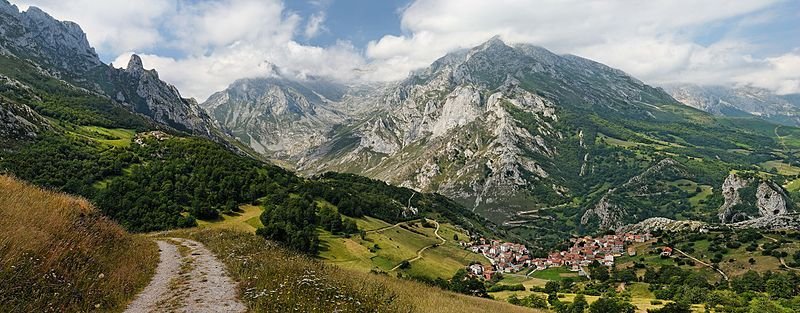
Asturias is home to a rugged coastline, lush pastures and the wild Cantabrian mountains which form the region’s natural border with the province of León to the south.
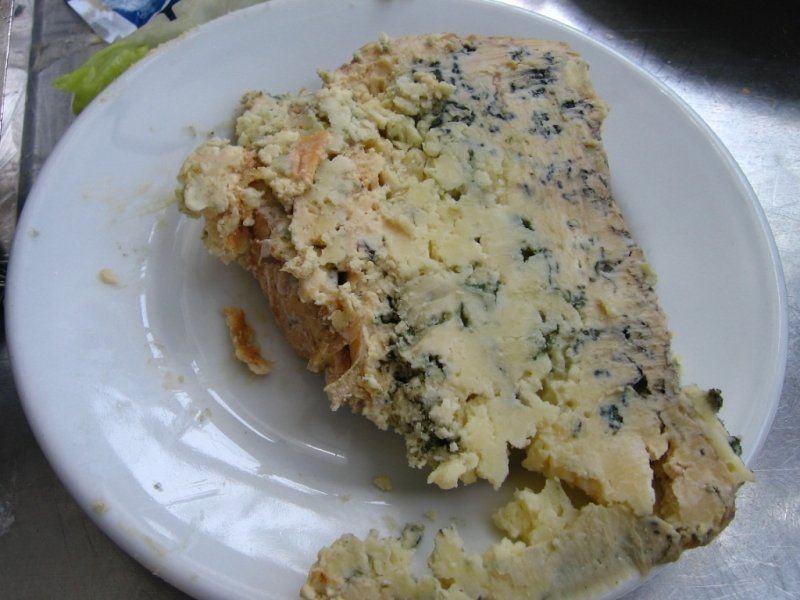
Thick forests support the highest numbers of bears in western Europe, while higher up gorgeous Alpine flower meadows erupt in early summer. Cows are everywhere; the sound of their bells might make you think you’re in Switzerland. Some claim the region has the highest the density of cheeses in the world. There are certainly a lot, many which hardly make it out of their own steep mountain valley.
The highest and arguably the most spectacular mountains are the Picos de Europa in the east of the region, which it shares with Cantabria and León. These rise to Pico Torrecerredo peak (2,648 m).
In the central east lies the heavily-forested limestone massif of Redes. The park, a biosphere reserve, is perhaps overlooked for the better known Picos de Europa.great route here is to follow the Ruta del Alba. The trail takes you along a river through gorges, wooden bridges, and beech forests. A great route here is to follow the Ruta del Alba. The trail takes you along a river through gorges, wooden bridges, and beech forests.
To the west is the wonderful mountainous natural park of Somiedo, a UNESCO Biosphere Reserve, while further west, Muniellos is home to the largest oak forest (Quercus robur) in Spain, and one of the best conserved in Europe although access in this case is restricted.
Coast of Asturias
The coast is made up of a complex succession of rugged cliffs, coves, sandy beaches and some coastal wetlands.
Cabo Peñas, located between Gijón and Avilés, is the most northernmost point in Spain. It features 100 m sheer cliffs. European storm-petrel nest in crevices in the cliffs and offshore islets.
There are a number of blowholes known as bufones along the Asturian coast, the best of which is perhaps the Bufones de Arenillas near the village of Puertas de Vidiago. Closeby is the similarly spectacular Bufón de Santiuste. Both of these blowholes are capable with the right tide of throwing up noisy shoots of water as high as 40 metres. They were formed by karstic and wave action. Bracing stuff.
See also Dinosaur coast
Just inland in the Sierra de Sueve is the largest yew forest in Europe
The region has a maritime climate with plentiful rainfall, and until recently at least moderate temperatures.
Traditional architecture in Asturias
Hórreos
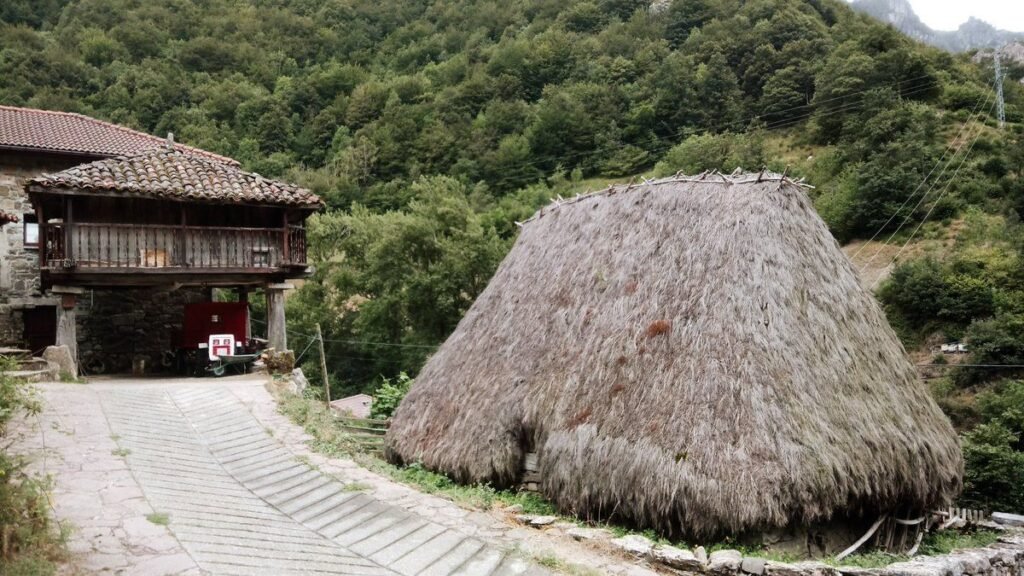
Hórreos are granaries found in Northern Spain. As can be seen in the photos they are raised off the ground by stone pillars known as “pegollos”, which can be made of either wood or stone. Hórreos have an extensive and regionally complex vocabulary associated with their different parts, but, to simplify, at the base of the hórreos are huge slabs of stone called “pilpayos”, on which the “pegollos” stand. These in turn are topped by a large flat stone called a “muela” which prevents rodents from getting in, the essential purpose of the hórreo. Then, a small stone is placed between the “muela” and the beams, on which the granary itself is built.
The sides are usually slatted for ventilation. They are found throughout north-east Spain , though particularly in Asturias and Galicia . They tend to be square in the former and rectangular in the latter. When I first saw hórreos in Asturias I fell straightaway for their chunky idiosyncrasy, a thousand tiny variations on the theme, each defying gravity. These days very few are still used as granaries. Some are used to keep firewood or even the car dry, or as a shed to store bikes and whatnot. Some lie abandoned. Some have been restored as folk monuments. They are often several or more in each village.
In Asturias , a panera is similar to an hórreo* but stands on 6 or more legs.
Social issues
But in addition to the idyll, there is also an Asturias of abandoned coal-mines, high unemployment and a constant drain of its youth to more prosperous parts.
The Gijón area, where 25% of the region’s population live, was marked out as a key pollution hotspot in Western Europe predicted for 2030 in a 2015 report from the International Institute for Applied Science Systems.